
Editor’s Note: Originally published in DB Issue No. 11, this story has been lightly edited to make it current.
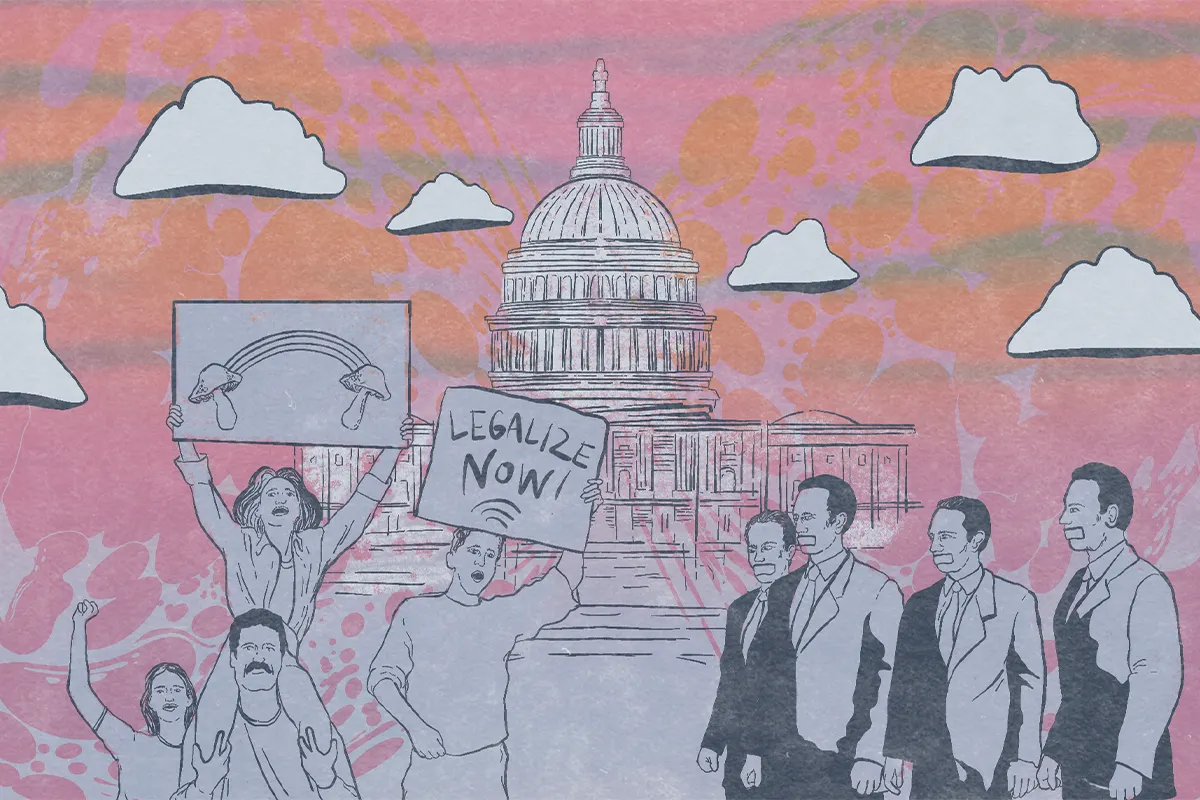
The job of the president means executing laws around all kinds of things: education, the environment, infrastructure, and — relevant to this story — drugs. During both of their terms, Trump and Biden had tons of leeway on how to enforce the rules around psychedelics. As head of the executive branch, the president is in charge of the justice system; the FDA (which can approve psychedelic medicines); the customs service that seizes drugs at the border; and more. And yet, as president, the most meaningful action that both Trump and Biden took on psychedelics was…nothing.
It’s been an eventful run-up to the presidential election. Amidst the chaos, however, neither candidate has lifted as much as a finger on psychedelics. While Harris has yet to take a stance on psychedelics, neither the Biden nor Trump administrations made moves to call off the DEA’s dogs — literally and metaphorically — to keep trippers out of prison; they didn’t ask the DEA to move psychedelics out of Schedule 1, the most highly restricted category on the Controlled Substances Act; and they didn’t call for more money for psychedelic research, even though this was the one action advocates were most hopeful they might rally behind.
Is any of this surprising? No. At least with Biden and Trump, neither ever had a sip of alcohol or taken a drug outside an approved medical setting (or so they say). I can’t find a time either one even uttered the word psychedelic. More importantly, voters in the swing states are, by and large, unsure or uninterested in psychedelics. And, yet — it’s worth remembering: Sometimes nothing can be a real cool deal.
READ: Psilocybin-Assisted Group Therapy Can Relieve Shame in People Living with HIV
There was a whole half-century when trippers would have loved for a president to have done nothing because most were doing something, and it was deeply un-chill: jailing users, spreading misinformation about psychedelics’ effects, putting forth anti-LSD propaganda.
Subscribe to the Drop In by DoubleBlind. Your essential newsletter covering the world of psychedelics. Trusted by 100k+ readers.
Trump and Biden were in charge as psychedelic reform crept ahead in regulatory agencies they controlled: as MDMA advanced toward becoming the first psychedelic approved by the FDA for use in therapeutic contexts (which it has since been denied by the FDA); as the National Institutes of Health gave out a $4 million grant to study psilocybin for tobacco dependence; and as the VA participated in psychedelic research.
In short, the last two White Houses haven’t made things better. But, they haven’t made things worse. For some psychedelic advocates, though, nothing isn’t enough.
“It pisses me the fuck off,” says Matthew “Whiz” Buckley, a former Navy fighter pilot and nonprofit leader. Buckley calls himself a “single-issue voter,” and his single issue is psychedelics. Buckley has made many trips to D.C. to get more money for psychedelics to help vets. “I’m furious” about the lack of action at the federal level, he says. Buckley is one of a growing number of people working within the psychedelic movement, from lawyers to patients, who want to rattle the cages of the establishment.
“This is a pitchfork and torch moment,” he says. Ignoring the boxes for Trump or Biden, Buckley has considered a presidential protest vote, throwing his weight behind independent Robert F. Kennedy Jr., more popularly known as RFK. (In the months since publishing this story, RFK has since pulled out of the presidential race and endorsed Trump.)
Kennedy is the son of Robert F. Kennedy and nephew of John F. Kennedy. His views are anti-establishment. He is a vaccine skeptic and a critic of big pharma. “My inclination would be to make this available — at least in therapeutic settings and maybe more generally — but in ways that will discourage the corporate control and exploitation,” Kennedy told YouTuber Joe Polish.
As someone with a former dependence on heroin, Kennedy was wary of psychedelics — just another thing to get addicted to, he thought. He became more open to psychedelics after one of his kids used ayahuasca in South America and returned as a changed person. “I’ve seen miraculous recoveries with psychedelic drugs,” Kennedy said in a Town Hall on NewsNation, where he also said he would legalize psychedelics.
Buckley says “all” his psychedelic-using Navy friends are voting for RFK. As a journalist covering psychedelics, I’ve also noticed a love for RFK at psychedelic events, from mushroom growers to a guy who is thinking of using psychedelics to treat his teenage kid. Psychonauts Aaron Rodgers, Aubrey Marcus, and Joe Rogan also praised Kennedy before he dropped out of the race, even though, according to the polls, he never really had a chance at winning.
This doesn’t mean, however, that there won’t be any movement around psychedelics on the federal front in the next four years. Support for psychedelics is spreading in Washington, notably, in the House of Representatives, where members have leeway to take more extreme stands. Psychedelic support is still small, but a rainbow coalition of liberal darlings like Alexandria Ocasio-Cortez and Republican bomb-throwers like Dan Crenshaw is forming.
“We’re not going to get funding without Republicans,” says Melissa Lavasani, CEO of the Psychedelic Medicine Coalition, a lobbying organization in DC.
Every House seat is up for grabs in November, and Congress has been “bombarded” by people urging them to study psychedelics, Ocasio-Cortez said in a press conference outside the Capitol in July 2023. “I know the power of this community to rise up and make itself heard,” said AOC. “And I expect they will again.”
There’s even the Psychedelics Advancing Therapies (PATH) Caucus, led by California Democrat Lou Correa and Michigan Republican Jack Bergman. Correa and Bergman have pushed forward many efforts to fund psychedelic research in the last couple of years. Most hit roadblocks.
READ: Big Pharma Executive Is Now Leading the Movement to Legalize MDMA
Then, late last year, the House had a big success — and a law changed. It changed for the same reason psychedelic laws often do: because some people with power actually tripped.
In this case, that includes Rep. Morgan Luttrell, a Republican from the Houston area. Luttrell is a former Navy Seal who suffered a traumatic brain injury in a helicopter crash during training. Luttrell has only done psychedelics one time, when he tried ibogaine and 5-MeO-DMT in Mexico in 2018. He called his trip an “exorcism.” “There was a lot of negative energies being exhausted mentally and physically,” Luttrell told me in an email.
Luttrell’s trips did not turn him into a liberal. Far from it. Luttrell still pushes for a traditional conservative agenda on most fronts: He helped make sure the military prohibits teaching critical race theory and freezes DEI hiring. Yet Luttrell was a driving force behind one of the biggest actions of the federal government on psychedelics, within the National Defense Authorization Act. Luttrell pushed to set aside in the defense department’s budget $10 million so active-duty military members who have post-traumatic stress disorder or brain injuries can be in psychedelic clinical trials.
Luttrell says it’s important to let military members into clinical trials because he hears stories of soldiers with PTSD who go to Mexico or Peru to heal with psychedelics and aren’t taken proper care of. Instead of participating in ceremonies abroad, he said, he’d rather have vets in clinical trials in the United States, where they can get follow-up care.
The military funding for psychedelics, as of this writing, has not received final approval. But it’s one more example — among many others, such as the support of psychedelic reform by Former Texas Governor Rick Perry and the donation to nonprofit MAPS by renowned Republican political donor Rebekah Mercer — whereby the need for novel mental health treatments for veterans has turned psychedelics into a bipartisan cause.
Generally, one of the strangest things about this moment in psychedelic history is how little organized opposition there is. There are calls for caution — usually along the lines of “we need more research” — but “more research” is what the proponents tend to want, too.
“I still can’t find one member of Congress that is against” psychedelic research, Rep. Crenshaw said in a news conference outside the Capitol in June 2023. “That’s an amazing thing.”
An opposition could arise, if there’s more bad news, such as recent headlines that an off-duty pilot tried to crash an airplane following a mushroom trip and a soldier tripping on mushrooms killing two at a music festival. Or, says Lavasani, psychedelics might be hamstrung if they are tied to ideas or cultures Republicans oppose or are frightened by, especially any kind of wokeness. “The headline we don’t need is, ‘psychedelics turn people into environmentalists,” she said.
The Psychedelic Caucus says it does not support decriminalization or adult use, even though residents in Washington, DC, passed a measure to decriminalize natural psychedelics in 2020 by a huge margin.
At this time, however, most of the political donations seem to be going to state-level campaigns. Advocates have already proven that it’s possible to change the laws at the city and state levels. Voters in Oregon and Colorado both legalized supported psilocybin sessions at the ballot box, and other states have looked to follow.
READ: Psychedelic Exceptionalism Harms People Who Take Antidepressants
But, regardless of state- and citywide momentum, two lobbyists I spoke to argue that it might be important to work at the federal level for there to be a significant dent in the current mental health crisis. 10 million people live in Oregon and Colorado. 10 million people isn’t a small number — but this country has 16 million veterans and 50 million people with a mental health condition. Researchers have always relied on grants from the federal government because there are no bigger barrels of cash than in Washington. Additionally, in order for there to be a shot at accessibility of psychedelic therapy, it must be paid for by insurance — and that can only happen with the federal government on board.
“You’ve got to work within the system,” says Jon Kostas of the psychedelic research advocacy nonprofit Apollo Pact. “The whole reason we’re in this situation is because of Congress and the Controlled Substances Act of 1970. So if people really want to see this become therapy and a medical treatment for folks in need, the way to do it is through the government.”
The election is coming soon. The question lingers. Will a Harris or Trump administration stop doing nothing about psychedelics, and start doing something?
It’s possible. Trump, in the ’80s and ’90s, wanted to end the drug war. He hasn’t said anything that radical about drug reform in a while.
A few people made a strong argument that the Biden administration could come around to supporting psychedelics. But does the same hold true for the possibility of a Harris administration?
Kostas says voters who care about psychedelics should be thinking more about their representatives in Congress than the next president. Bergman, Correa, Luttrell, and Ocasio-Cortez are all among the representatives who could push psychedelic reform forward more than whoever is in the White House next term.
“Those,” says Kostas, “are the champions you need.”
DoubleBlind is a trusted resource for news, evidence-based education, and reporting on psychedelics. We work with leading medical professionals, scientific researchers, journalists, mycologists, indigenous stewards, and cultural pioneers. Read about our editorial policy and fact-checking process here.
DoubleBlind Magazine does not encourage or condone any illegal activities, including but not limited to the use of illegal substances. We do not provide mental health, clinical, or medical services. We are not a substitute for medical, psychological, or psychiatric diagnosis, treatment, or advice. If you are in a crisis or if you or any other person may be in danger or experiencing a mental health emergency, immediately call 911 or your local emergency resources. If you are considering suicide, please call 988 to connect with the National Suicide Prevention Lifeline.
DoubleBlind Mag Read More