
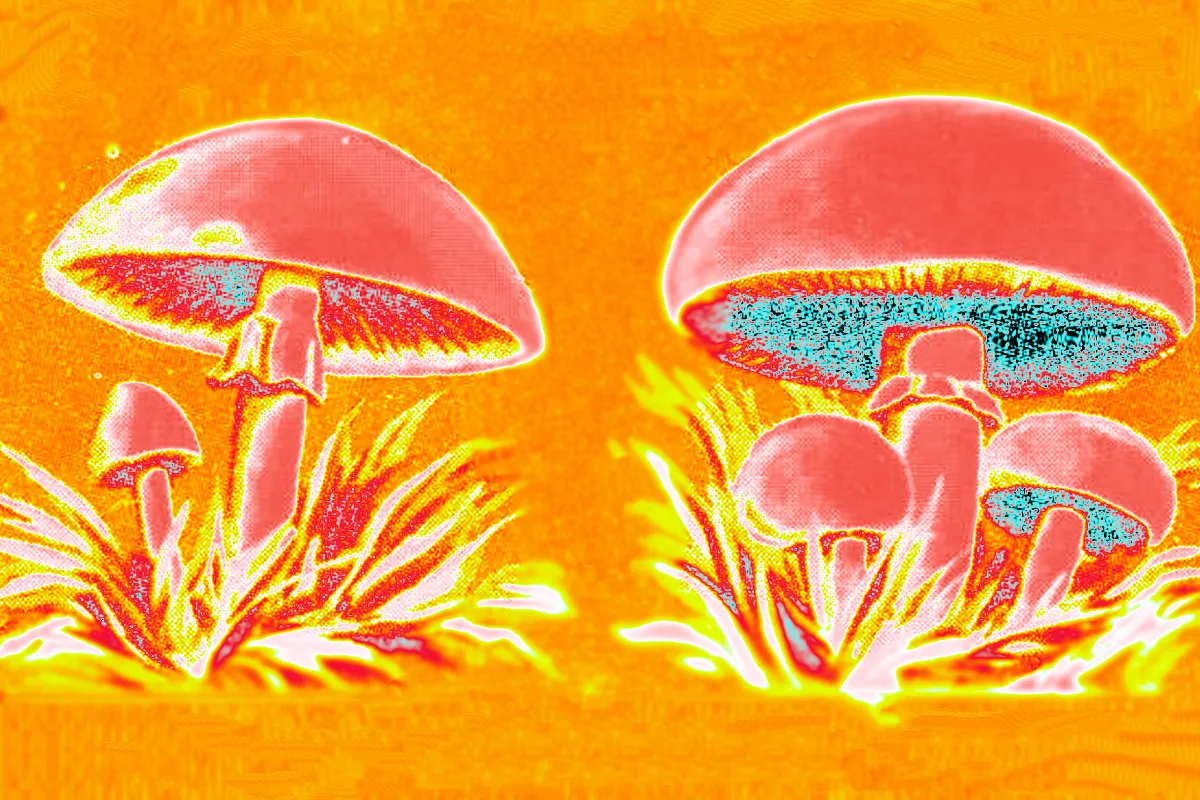


Ask a random stranger to draw you a mushroom, and they’ll probably draw you the iconic umbrella shape — maybe a fly agaric if they’re feeling artistic, or a boring button mushroom if they want you to leave them alone. However if you ask a mycophile to draw you one, you might get as many different species as the people you ask.
The word “mushroom” typically applies to the fruiting bodies of the basidiomycetes and ascomycetes (so-called “higher fungi” and “cup fungi,” respectively). Growing all over the world, fungi and the mushrooms they produce have adapted to various habitats and ecological roles. Flick through any fungal identification guide and you’ll see many different forms, some which bear little resemblance to what most would consider a typical mushroom.
Differences in anatomy can offer crucial bits of information to help you identify a mushroom you might have found while out in nature, so in this article we’ll try and cover some basic broad-brush anatomy and some common example mushrooms — keeping note of how certain forms might differ between species.
Parts of a Mushroom and Their Functions
Stipe
Sometimes informally called the stem or stalk, stipe is the technical mycological term for the part of the mushroom that holds up the cap. Unlike a plant’s stem, which is used to transfer nutrients and water between the roots and leaves, a mushroom’s stipe is far less complex and simply holds the cap aloft to let it do its spore dispersal thing.
Subscribe to the Drop In by DoubleBlind. Your essential newsletter covering the world of psychedelics. Trusted by 100k+ readers.
Stipes can take on various shapes, lengths, colors, and textures, and can be solid or hollow in the center. The stipe of some mushrooms may show some sort of ring where a partial veil (the membrane covering the underside of the cap in some species) had once been attached. Others may have stems that are covered in a fine net-like pattern, which is called reticulation. Some mushrooms (including tree growing polypores like reishi and turkey tail and ground growing mushrooms like puffballs and earthstars) have a stipe that is very short or missing entirely.
Cap
The cap holds the parts of the mushroom responsible for releasing the spores — usually the gills, pores, or teeth. Caps usually start out very small, but can quickly grow in size and significantly change their shape as a mushroom matures. Like the stem, the cap can show a wide variety of growth forms — from the hygrophanous caps of many magic mushrooms that change color depending on their moisture content, to the bioluminescent caps of many glow in the dark fungi. Some species, like lion’s mane, lack any distinctive cap.
The fly agaric is well-known from the bright white spots covering its intense red cap. These spots are from what’s known as the universal veil, which in younger mushrooms fully envelopes not only the cap, but the whole fruiting body itself.
The cap of the shaggy ink cap (Coprinus comatus) actually dissolves (or more technically “deliquesces”), digesting itself to release the spores in a black inky mess — hence the name.
Scales
Both the cap and stem can be covered in scales or hair-like structures, or have distinctive textures or patterns. Such features tend to be where mycologists tend to flex their technical vocabulary, with words like “areolate” (cracked), “fibrillose” (hairy), “floccose” (wooly), “scabrous” (scaly), and “verrucose” (warty, but only slightly) to name a few. Knowing these features can help you in your mushroom identification, and can incidentally make you lethal in a game of Scrabble.
Undersides
Typical mushrooms have a topside (the part you see when parting some grass and peering down on them from above) but the underside is usually where the real mushroom magic happens — the dropping of the spores. Spores are the beginnings of new mycelium, and ultimately mushrooms. Though many consider spores to be similar to the seeds of plants, spores only contain half the genetic material of their parent, meaning that fungal sex typically happens in the soil, instead of with the flowers and fruit we associate with plants. In most cases, the spores emerge from gills, pores or teeth of the mushroom.
Ridges. Gills are a commonly encountered feature of the underside of many mushrooms. If you slice the cap off the mushroom and flip it over, the gills can be seen joining the stem in a radial pattern, like the spokes of a bicycle wheel. This specific pattern of the gill can help you identify the mushroom you’re looking at, as can the way in which the gills attach to the stem itself.
Pores. Some species of mushrooms, such as the boletes and polypore fungi, release their spores through pores instead of from their gills. This gives the underside of these mushrooms the appearance of a sponge, covered in thousands of tiny holes.
Teeth. Other mushrooms have small spore-releasing spines hanging down from their underside. These teeth can range from very small (and can sometimes be mistaken for pores), to clearly visible, as in the case of lion’s mane. Mushrooms with teeth were thought to all be closely related, and were originally classified as being in the same genus (Hydnum spp). However, later studies revealed that tooth-bearing fungi exist across lots of weakly related species, and many have been reclassified today.
What Parts of a Mushroom are Edible?
If you’re confident you’ve found an edible mushroom, then all parts of it are usually edible — though palatability is a different matter. Sometimes the pores of boletes can become soggy and bitter, so some foragers prefer to remove these (luckily they peel off easily). Older chicken of the woods can become quite tough, so these mushrooms are typically harvested young, or just the soft growing tips are removed for a tasty dinner. Edible mushrooms with an unpleasant mouthfeel can always be used for stock or tinctures, so if you harvest some by mistake you don’t necessarily have to throw it out.
It’s important to always be sure of what you’ve found before eating any part of a mushroom, so avoid consuming if there’s any doubt. Also, check your wild foraged mushrooms thoroughly, as they make great homes for maggots and other baby insects. If you want to avoid this extra protein, drying your mushrooms is a great way to encourage any creepy-crawly visitors to head for the exit.
Cordyceps Anatomy
Cordyceps is a genus of fungi which mostly feed by parasitizing insects and other bugs. If you’ve seen The Last of Us, or played the game it’s based on, you might recognize references to a mutated strain of Cordyceps as the cause of the story’s zombie apocalypse. Though in reality us humans are safe (for now!), the most commonly cultivated mushroom species, Cordyceps militaris, has some pretty unusual features adapted to its role in taking over insect bodies.
Instead of a defined cap, the orange stipe continues into a club-shaped head. This head is covered in microscopic pores which open into individual chambers called perithecia (singular: perithecium). These chambers produce the ascospores — microscopic “packets” containing eight spores each. Probably the most gnarly aspect of wild Cordyceps mushrooms is the fact that, although they appear to sprout from the ground, if you dig down carefully you’ll be able to unearth the poor insect that ultimately succumbed to its fight with a fungus.
Morel Mushroom Anatomy
Morels (Morchella spp.) are a group of highly prized edible mushrooms, but some can be toxic if eaten raw. They are particularly difficult to cultivate, and wild-foraged specimens fetch a high price. Like Cordyceps, they are another ascomycete (cup fungus), and lack the classic umbrella-shaped cap most might associate with the word mushroom. The irregular cap has an open sponge-like or honeycomb texture — with a lattice of ridges separating deep pits that contain the ascospores. Differences in the anatomy of the cap can be used to help narrow your identification down to species level, by paying attention to differences in shape, color, and the contrast between the pits and ridges. Foragers first finding morels are usually surprised to find both the cap and stipe are both hollow.
Oyster Mushroom Anatomy
The many types of edible oyster mushrooms (Pleurotus spp.) are all basidiomycetes, and although their anatomy might be considered more typically “mushroom,” they still have some interesting features. The genus name is a mixture of Ancient Greek “πλευρά” (pleurá), meaning “side” and Greek “ὠτός” (-oto) meaning “ear,” which refers to how the stipe attaches sideways or off-center to the cap as the mushroom emerges from its woody substrate — usually a dead or dying tree. The caps of young oyster mushrooms are distinctly lobed, unfurling into a broader undulating fan shape as they mature. The gills of this mushroom extend down the short thick stipe (a term mycologists call decurrent). Some species and strains lack a stipe altogether, with the cap appearing to burst directly from the tree.
The mycelium of Pleurotus ostreatus (and likely other oyster species) can also capture and digest microscopic worms, but you’d need a microscope and a keen eye to spot this.
Commercially cultivated king oyster (P. eryngii), is one of the few oyster species that doesn’t have an offset stem. When cultivated, it often grows from the top of the substrate (rather than from the side like other oysters), and resembles the more typical mushroom shape most would think of.
DoubleBlind is a trusted resource for news, evidence-based education, and reporting on psychedelics. We work with leading medical professionals, scientific researchers, journalists, mycologists, indigenous stewards, and cultural pioneers. Read about our editorial policy and fact-checking process here.
DoubleBlind Magazine does not encourage or condone any illegal activities, including but not limited to the use of illegal substances. We do not provide mental health, clinical, or medical services. We are not a substitute for medical, psychological, or psychiatric diagnosis, treatment, or advice. If you are in a crisis or if you or any other person may be in danger or experiencing a mental health emergency, immediately call 911 or your local emergency resources. If you are considering suicide, please call 988 to connect with the National Suicide Prevention Lifeline.
DoubleBlind Mag Read More