
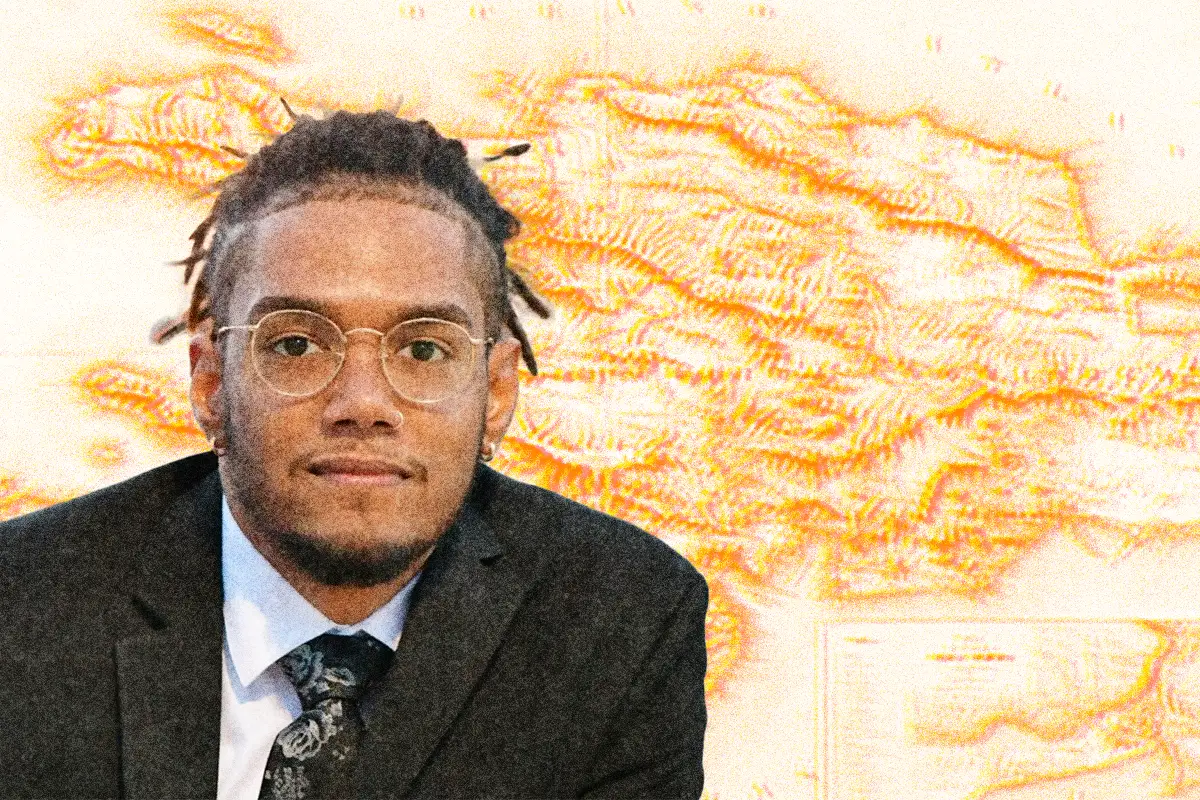


Working at the nexus of education, policy, and therapeutic practice, systems thinker Victor Cabral regularly navigates institutionalized power in order to create decolonized systems of care, particularly for those most impacted by historical harms. Building and nurturing community is an integral part of Cabral’s work in psychedelics. As a social worker and activist, he believes genuine efforts to decolonize must start from within before being expressed in the world.
The first time Cabral worked with mushrooms was in 2016. The experience expanded his understanding of mental well-being and the ways in which the traditional healthcare system can disinhibit healing.
“I was working in a community mental health clinic as a therapist, giving people medications that were not really doing anything for them,” Cabral tells DoubleBlind. I was feeling really conflicted. Since then, I have oriented myself to doing this work for my community.”
In this installment of Decolonizing Psychedelics, series founder Preeti Simran Sethi talks to Cabral about the impacts of colonialism and white supremacy on people of all races, the role we collectively play in decolonizing psychedelics, and ways to stay centered as we manifest change.
READ: The Western Medical Model for Psychedelics Is Built on Cultural Erasure
DoubleBlind: To start, how do you name yourself?
Victor Cabral: I am a cis-hetero, Black Latinx male. I am a social worker. I am a therapist and an activist. That takes shape in many different forms. Whether it is through art, policy work, or sitting with folks, my work is to really serve my community. I am currently the Assistant Director of Community Care at the Naropa University Center for Psychedelic Studies. I am also working on a film called “We Are the Medicine” that explores psychedelics from the perspective of people of color.
What brought you to psychedelics?
Talking to a friend who had had an experience with psychedelics and learning about my family’s history with psilocybin in the Dominican Republic. In 2016, I made the choice to take the medicine. It was like I was searching for myself and I found him.
When I found this medicine for myself, my first question was, “Why aren’t we talking about this?” I was working in a community mental health clinic as a therapist, giving people medications that were not really doing anything for them. I was feeling really conflicted. Since then, I have oriented myself to doing this work for my community.
You have helped guide policy, inform psychedelic facilitator trainings, and build local health initiatives. In your estimation, how has colonization shaped psychedelics?
I have a mentor who says, “The beginning is the middle and the end.” If you apply that to our collective history, how the United States was established, how the dominant powers in the world got to be who they are now and gather all their wealth, it was through colonization: brutal, displacing genocide; stealing, raping, and pillaging. All of those ways of treating other human beings and extracting resources are baked into our geopolitical, national structures. The Psychedelic Renaissance is operating within those structures, embedded within a system rooted in colonization.
In your public policy work, you engage within those structures of power in order to make psychedelics more available. How does it feel to navigate those spaces?
It is a necessary evil to engage those systems because that is where the power to move things is. It takes effort to keep balance, to not lose yourself, to stay connected to community and those struggles, and strive to develop a new way of care for one another. So that when you are doing the policy work, you do not get lost in the political sauce, as they say. For me, it is about being clear on why I am there: fighting to open up the legal landscape while also trying to build capacity and institutions that are rooted in a decolonial, anti-oppressive, social justice-oriented way of engaging with not just the medicines, but society at large.
You mentioned building decolonial institutions. How do you define decolonization?
Decolonization is multifaceted in terms of how it shows up, how we practice it, and how we talk about it. And it is also layered in that it addresses the colonial foundations of the world throughout Africa, Asia, Australia, everywhere. It [requires] looking at the political, economic, cultural, psychological, and social implications of colonialism and how it still shows up in our lives today, and working to deconstruct that at the individual, community, and collective level.
How do we achieve that?
There are many different ways. The work is in deconstructing and in [forging] models that are co-created in community with the folks most impacted by the colonial systems that are still wreaking havoc. Those behaviors don’t only impact the global majority; white folks are also stuck in this machine that was created. Báyò Akómoláfé says something along the lines of “whiteness has imprisoned white people just as much as it’s imprisoned everyone else.”
READ: The “Psychedelic Renaissance” Is a Product of Late-Stage Capitalism
So we are deconstructing while also co-creating in community what we want to see in society. Whether you are doing that on a personal level or at the organization that you are working at or in the federal government, you are doing the work. Whether you are with Indigenous communities or Latino communities, or wherever you are doing it—it is the work.
Everyone has a place in decolonizing psychedelics and there is so much healing to do.
I came into this movement really idealistic, kind of bright-eyed and excited. And I am still excited. But what I realized was that, while I respect and honor everyone who is doing the work at different levels, for me, the most important work is my personal work. So when it comes to decolonizing, [I am examining] my own spirit and within my family unit asking, “How am I decolonizing my household? How am I examining power dynamics between me and my wife and me and my daughters? How am I examining having privileged or dominant identities in this society? I am educated; I am middle to upper-middle class. How am I engaging with those things on a personal level? Whatever I create is going to be an extension of who I am and it is only going to go as deep as the work that I’ve done on myself.
That is powerful.
At some point we have to move from that personal level to the collective level, but how are you doing that [broader] work in tandem with personal work and with the wider society or the institution that you are working with? If you’re not [doing the personal work], you’re going to replicate whatever patterns are already part of your own life.
Psychedelic practitioner trainings, clinical trials, and service centers have been created in a Global North construct: a clinical medical model, a Western educational model, nested within a capitalist exchange. Is it possible to decolonize institutions of colonial power like the academy and government? And, maybe more importantly, is it possible to decolonize through them?
We don’t know [what lies beyond] the vision that we have. But if we are all centered around decolonization as we work within the system, we are shifting things. If you are in the psychedelic space, how are you building your institution? Is it hierarchical or one where the leadership is flat? Is it inviting of different voices? Is it equitable?
The other thing that is important to be clear about is that we are talking about deconstructing colonialism—psychologically, economically, in all of these different ways. It is going to impact the Asian community differently than it impacts the Latino community, and differently than it impacts the Black community. Although there are places where we will all be positively impacted, the implications for a particular community might be different. We need to hear different perspectives and experiences so that the policies or models of care that we create are as inclusive as possible.
In communities of [decolonized] practice, we can create the flow of information, connection, and collaboration. That’s the grand vision. So making sure that when I show up to advocate, I am not just talking about Black and Brown folks and forgetting about Asian folks, LGBTQIA+ folks, et cetera. I need to have engaged with those communities in a way that when I go into a policy office, I can really speak to what is going to be beneficial to the many folks that are impacted by the systems that are harming us.
… and that is collective liberation because it’s born out of collective understanding. I appreciate how you centered the self first. For those who have not done a lot of self-inquiry around how they are colonized or have colonized others, expressions of decolonization — such as “right relationship” and “reciprocity” — present as buzzwords rather than embodied or deeply considered. I am curious if you have seen that and how you suggest folks build deeper, more meaningful bridges.
It is a symptom of white supremacy that you see all the time. The colonial system either takes all of the nuance out of [something] so we can commodify and simplify it, or overly-focuses on nuance to avoid [accountability]. I have been guilty of it many times. I was talking to a family member this morning where, you know, I hear comments Dominicans make about Puerto Ricans or Puerto Ricans make about Dominicans. They are rooted in colonization.
Hanifa Nayo Washington says, “Speak truth to self first, and then to others.” In that, our embodied practice becomes a mirror. If you are doing the work within yourself, you can understand where someone else may be stuck or resistant. I, personally, do not want to spend too much time with someone or an institution that is not willing to look in the mirror. I hope and wish the best for them, and if there is a point where I can support them, I will. But I focus on the places where I feel like my being is going to have an impact.
You mentioned both decolonization and anti-oppression work. What distinction do you make between them?
For me, it is all part of the same work. Colonialism is a particular focus in psychedelics. But whether you are doing decolonization work or anti-oppressive work where you are actively challenging institutions to change patterns of oppression in behavior and policy, it is all in the same bucket. It is all about collective liberation.
###Preeti Simran Sethi is a writer, educator, mental health coach, and psychedelic support who advocates for culturally attuned care in psychedelics. Find more on her work here. This interview is made possible with editing support from Andrea Lomanto and the Ferriss-UC Berkeley Psychedelic Journalism Fellowship. It has been edited and condensed for clarity.
DoubleBlind is a trusted resource for news, evidence-based education, and reporting on psychedelics. We work with leading medical professionals, scientific researchers, journalists, mycologists, indigenous stewards, and cultural pioneers. Read about our editorial policy and fact-checking process here.
DoubleBlind Magazine does not encourage or condone any illegal activities, including but not limited to the use of illegal substances. We do not provide mental health, clinical, or medical services. We are not a substitute for medical, psychological, or psychiatric diagnosis, treatment, or advice. If you are in a crisis or if you or any other person may be in danger or experiencing a mental health emergency, immediately call 911 or your local emergency resources. If you are considering suicide, please call 988 to connect with the National Suicide Prevention Lifeline.
DoubleBlind Mag Read More