
But by the 1970s, the price of this type of growth was becoming clear. A landmark 1974 federally sponsored study called “The Cost of Sprawl” found the land, pavement, and utilities needed for suburbs and exurbs made them the “most expensive form of residential development.” (Denver’s 1929 plan also mentioned the lower infrastructure costs of denser cities, but warned of traffic and other “evils.”)
In spite of its cost, local governments in the Denver region have continued to embrace sprawl. By 2021, about 80 percent of land zoned for residences only allowed single-family homes according to research led by Carrie Makarewicz, associate professor and chair of the University of Colorado Denver’s urban and regional planning department.
“The national ethos — the American Dream — is to have your own single-family home, your own backyard,” she said.
But federal infrastructure spending that helped make the suburbs possible fell steadily between the 1980s and 2010s, leading to crumbling bridges and overtaxed highways. In Colorado, the Taxpayer’s Bill of Rights limits local governments’ ability to raise money for infrastructure. Cities here have increasingly turned to “metro districts” to fund it, but those pass along the costs to new residents through high property tax bills.
“We have not admitted to ourselves that we cannot keep relying on those good old days of funding infrastructure for all that growth,” Makarewicz said, adding: “We’re riding a wave. It’s about to hit shore.”
(The massive 2021 federal infrastructure spending bill and Colorado’s own recent big transportation funding bill will help shore up the state’s infrastructure, Makarewicz said, but added that they are only needed because of sprawl’s fiscally unsustainable nature and decades of disinvestment.)
At the same time, she said, Colorado’s rapid economic and population growth has collided with local regulations that limit new home construction. That’s a main driver behind the steep increase in home prices and rents here, she said. (Other, more global economic factors like inflation and high interest rates don’t help either.)
Makarewicz’s research shows that middle-type housing — two- to nine-unit residences, roughly similar to what the new bill would allow — accounted for just 2.2 percent of housing permits issued between 2005 and 2020 in the Denver metro.
Multifamily housing also tends to be cheaper than single-family homes in the same community because they are often smaller, and they make more efficient use of costly land and existing infrastructure, Makarewicz said.
Every Denver metro county has a shortage of small homes and an excess supply of large homes in relation to each county’s demographics, her analysis shows.
So will more housing help? Here’s what research says
The new bill would force many local governments in Colorado to allow multifamily housing — from townhomes to multiplexes up to six units — and accessory dwelling units in all residential zones.
The Colorado Municipal League, which represents many of the state’s cities and opposes the bill, said in an analysis that it relies on “speculation” that more housing will cause a market-based decline in housing costs.
But research suggests there’s a direct connection between the two. A 2018 review of studies from the New York University Furman Center said “there is a considerable body of empirical research showing that less restrictive land use regulation is associated with lower prices.”
One study, for example, in Massachusetts found that increases in minimum lot sizes (a precursor to more sprawling development) were followed by significant price increases. Another, using data from 100 cities in Florida, found that putting in more restrictive development regulations decreased land prices but increased home prices. One recent study directly linked restrictive local land use regulations to an increase in rates of homelessness.
Further, a 2021 University of California, Los Angeles review of a half dozen studies found strong evidence that building new market-rate apartments slows down rent increases for nearby existing housing, helping to keep neighborhoods generally more affordable. .
“It’s basic economics 101,” Makarewicz said, adding: “We don’t have adequate amounts of housing to meet the demand.”
The “most persuasive” evidence to support the Econ 101 theory, said Emily Hamilton, senior research fellow at the Mercatus Center at George Mason University, is that U.S. cities like Houston with less restrictive rules on housing tend to be cheaper.
“They make small-lot single-family construction possible that isn’t seen on a scale anywhere else in the country. They permit tons of multi-family housing,” Hamilton said.
Overall, Makarewicz said, Gov. Polis’ bill amounts to a “significant” step toward making housing more affordable in Colorado — especially in conjunction with other capital “A” affordable housing strategies like Proposition 123.
“It’s lifting off the barriers to what the market would probably provide and people would occupy if permitted,” she said of the new bill.
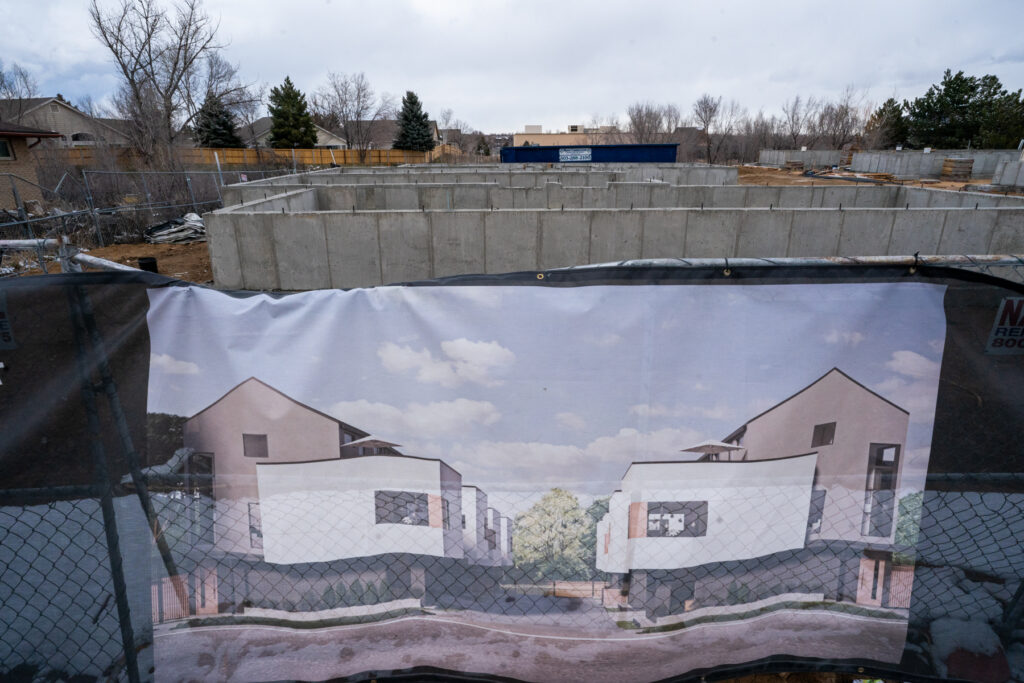
Hart Van Denburg/CPR NewsConstruction underway on six townhomes being built on the site of a former single-family home in Wheat Ridge, just west of Denver, March 27, 2023.
Wait a minute: Denver’s built a lot of housing in the last decade, and become more unaffordable too. What gives?
The city’s apartment boom of the last 10 years or so likely helped sustain its rapid job and population growth over the same period, Makarewicz said, by getting supply closer to demand.
But given that many of those jobs were high-paying, those new job holders, and the developments built to house them, have contributed to the “massive problem” of displacement of lower-wage residents.
Denver and about two dozen other Colorado cities have made a key policy change recently that should help curb displacement going forward, she said: they’ve passed “inclusionary zoning” rules that require large multifamily residences to include some affordable units.
“Density, if done well with affordability included, does not have to equate with gentrification and displacement,” she said.
Polis’ bill does not mandate inclusionary zoning, except in areas near transit stations, though it does require local governments to identify areas ripe for displacement and use other methods to try to prevent it.
Some state lawmakers are taking a different approach to fight displacement — attempting to allow local governments to pass limited forms of rent control. Polis has signaled he will oppose that bill.
Polis’ proposal would also cut parking requirements. That could help with affordability, too.
How much parking a new apartment or condo building will include is often a flashpoint in development fights, with nearby residents worried their on-street spaces could also disappear. But research shows requiring new buildings to include dedicated parking can drive up costs and harm affordability.
A 1998 study of parking requirements in six San Francisco neighborhoods found that single-family homes and condos were 10 percent more costly if they included off-street parking.
That work was later expanded on in UCLA professor Donald Shoup’s influential book, “The High Cost of Free Parking.” He argues that parking mandates are a key contributor to urban sprawl in addition to driving up home prices.
Closer to home, a 2020 Regional Transportation District study found that developers had built far too many parking spaces in new apartments and condos near transit stations. Those unused spots, in a parking structure, cost about $25,000 to build — and those costs are passed on to residents through higher rent, RTD said.
The new bill would not prevent developers from building parking spots for new multiplexes if they believe it makes economic sense. Rather, it would prevent localities from requiring they be built.
Makarewicz said the prospect of more density means cities and the state may have to step up their planning efforts.
“Bad density” does exist, Makarewicz said, like when cities build high-rises in areas with no public transit or other nearby services.
“Density without good planning, without transit, without walkability, without a mix of uses, can be bad for the occupants and for the surrounding area,” she said.
The bill doesn’t include funding for increasing public transit service. But Polis said it “strengthens the economy around transit” by allowing more homes near stations, and added that he’s “excited” to look at additional options the state may have to support transit.
Colorado Public Radio Read More